

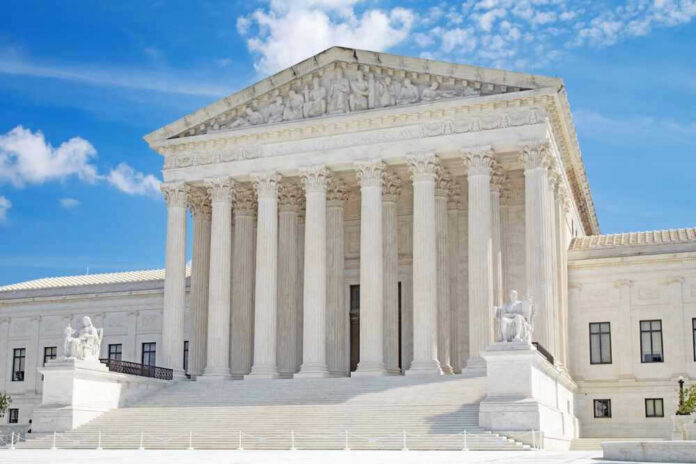
The Supreme Court delivered a unanimous victory for law enforcement on January 14, 2026, affirming that police officers can enter homes without warrants during legitimate emergencies, rejecting dangerous attempts to impose criminal probable cause standards on life-saving welfare checks.
Story Highlights
- Supreme Court unanimously upholds Montana police’s warrantless entry during a suicide emergency
- Court rejects leftist push for probable cause requirements that would delay life-saving interventions
- Decision resolves national circuit splits and strengthens law enforcement authority nationwide
- Montana Attorney General hails ruling as “huge win” for officer safety and community protection
Court Reinforces Emergency Aid Exception
Justice Elena Kagan authored the unanimous decision in Case v. Montana, clarifying that officers need only an “objectively reasonable basis” for believing someone requires emergency aid before entering a home without a warrant.
The ruling stemmed from a 2021 incident in Anaconda, Montana, where police responded to reports that William Case had threatened suicide and possibly shot himself. Officers observed an empty gun safe and blood-like substances before entering the residence, where Case later emerged armed and assaulted an officer.
🚨BREAKING🚨
The Supreme Court just ruled 9-0 that a warrantless "welfare check," where police shot Trevor Case in his own home, was justified in Case v. Montana.
Apparently, police DO NOT need probable cause to break into gun owners' homes WITHOUT WARRANTS & shoot them. https://t.co/S2KHSx3Mos pic.twitter.com/hWrTWu7UqT— Gun Owners of America (@GunOwners) January 14, 2026
Rejecting Probable Cause Overreach
The Court explicitly rejected attempts by some lower courts to impose criminal probable cause standards on emergency aid situations. This represents a crucial victory against judicial overreach that would have handcuffed police during crisis responses.
Montana Justice Laurie McKinnon had dissented in state court, advocating for probable cause requirements that the Supreme Court dismissed as fundamentally misguided. The decision builds on the established Brigham City v. Stuart precedent while distinguishing it from the restrictive Caniglia v. Strom ruling that limited community caretaking functions.
Montana Attorney General Austin Knudsen, who argued the case before the Supreme Court, celebrated the outcome as validation for officers nationwide. Chief Bill Sather of Anaconda-Deer Lodge police expressed relief that the Court recognized the practical realities of emergency response.
The ruling eliminates confusion that had emerged from inconsistent circuit court decisions, providing clear guidance that prioritizes public safety over bureaucratic warrant procedures during genuine emergencies.
Protecting Constitutional Law Enforcement
This decision represents a common-sense application of Fourth Amendment principles that recognizes the difference between criminal investigations and emergency welfare checks. The Court’s reasoning emphasizes objective reasonableness rather than the elevated standards typically required for criminal prosecutions.
Officers responding to suicide threats or medical emergencies should not be forced to waste precious time obtaining warrants when lives hang in the balance, a principle that aligns with both constitutional text and practical necessity.
An appropriate, unanimous decision. "Supreme Court sides with Montana police on warrant requirements during emergencies"https://t.co/lg294h8Jl9
— Rob Douglas (@RobDouglas3) January 14, 2026
The unanimous nature of the decision demonstrates that even liberal justices recognize the fundamental importance of enabling police to respond effectively during genuine emergencies.
The ruling establishes a uniform standard for Fourth Amendment application across all federal circuits, reducing litigation costs and providing clear operational guidance for law enforcement agencies.
This outcome strengthens the constitutional framework that protects both individual rights and community safety, rejecting the false choice between constitutional compliance and effective emergency response that some activist courts had attempted to impose.
Sources:
Court finds police properly entered man’s home despite absence of a warrant
Supreme Court backs warrantless entry in emergencies
Supreme Court Opinion Case v. Montana
Cornell Law Supreme Court Case 24-624