

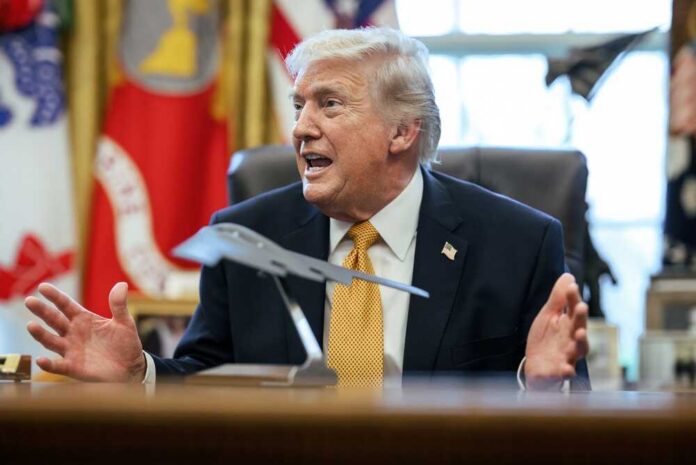
President Trump told his Homeland Security Secretary to start talking with Democrats about immigration reform, but he made one thing clear: amnesty is off the table.
Quick Take
- Secretary Markwayne Mullin says Trump personally told him to begin working with Democrats on immigration legislation.
- Mullin insists no policy change on enforcement has been discussed and amnesty “will never happen.”
- He is open to Congress giving DACA recipients a path to permanent legal status, a position some conservatives call amnesty by another name.
- Conservative figures, including a former Border Patrol chief, accuse Mullin of betraying the administration’s deportation mandate.
What Mullin Says Trump Told Him
Mullin told Fox News that Democratic lawmakers had reached out about immigration talks, and he took the question straight to the president. According to Mullin, Trump’s answer was simple: “Let’s start working with them and then let’s meet at some point.” That single quote is the foundation of everything that follows, including the backlash now hitting Mullin from his own political corner.
Mullin was also asked directly whether he and Trump had discussed changing the administration’s enforcement approach. His answer was blunt: “No, we haven’t had that conversation.” That distinction matters. Talking to Democrats about legislation is not the same as softening enforcement. Mullin wants the public to see those as two separate tracks, even though critics keep blending them into one.
Where Mullin Draws the Line
Mullin has repeated, in more than one setting, that amnesty “will never happen” under Trump’s watch. At the same time, he has floated the idea that Congress could give DACA recipients a route to “legal permanent citizens or something like this.” That one sentence is where the political trouble starts, because it sounds to many ears like exactly the kind of legalization conservatives fear.
The gap between “no amnesty” and “permanent legal status for some” is not clearly defined anywhere in Mullin’s public remarks. He has not laid out a bill number, an eligibility list, or enforcement triggers. Without that detail, both sides get to fill in the blank with their own fears or hopes, and that ambiguity is doing a lot of the political damage right now.
Conservative Base Pushes Back Hard
Former Border Patrol Chief Gregory Bovino did not hold back, saying plainly that “voters asked for mass deportations” and questioning why the man running Homeland Security was making the case for reform instead. Conservative commentator Robby Starbuck went further, calling Mullin’s posture “a total betrayal” of the people who elected Trump expecting aggressive enforcement, not a new negotiating table with Democrats.
The reaction spread quickly beyond individual commentators. The Heritage Foundation and the House Freedom Caucus both posted public “No amnesty” statements after the story broke, and Missouri Representative Bob Onder wrote that he would accept “NO amnesty for illegal aliens.” None of these responses point to a finalized proposal from Mullin or the White House. They are reacting to tone and possibility, which is itself telling about how little trust exists on this issue inside the Republican coalition right now.
From a common-sense standpoint, the skepticism is fair. Voters backed Trump on a clear promise of enforcement, and any hint of legal status for people who entered the country unlawfully deserves hard scrutiny, not a rushed deal. At the same time, distinguishing a narrow, conditional DACA fix from blanket amnesty is not automatically a betrayal. The problem is that Mullin has not yet shown his work, and that vacuum is exactly what critics are filling with worst-case assumptions.
History’s Lesson on Reform Versus Amnesty
This fight is not new. The Immigration Reform and Control Act of 1986 paired tougher employer rules and more border enforcement with legal status for nearly three million people already in the country. Supporters called it a balanced trade; critics later said it rewarded illegal entry and encouraged more of it. The same argument, enforcement now in exchange for legal status for some, is playing out again with Mullin and Trump, decades later and with the same unresolved tension between practicality and principle.
What happens next likely depends on whether Mullin and the White House put real text on paper, something Congress can score, debate, and vote on, rather than talking points traded through cable news. Until then, every side gets to call it whatever serves their argument best, reform, betrayal, or a trap waiting to spring.
The coming weeks, and whether a real bill with real restrictions ever appears, will tell conservatives whether their worry was justified or whether Mullin’s “no amnesty” line actually holds.