
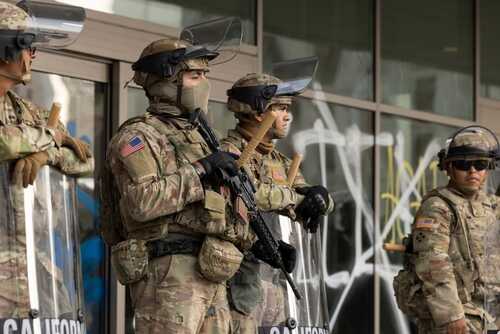
President Trump’s federalized National Guard deployments to Democrat-run cities ended in a quiet retreat after the Supreme Court blocked his unprecedented attempt to seize control of state troops, marking a rare victory for constitutional limits on executive power.
Story Highlights
- Trump withdrew federalized National Guard troops from Chicago, Los Angeles, and Portland after the Supreme Court rejected his authority to deploy them for domestic crime enforcement
- The $500 million operation ended quietly in January 2026, following multiple court defeats, with over 5,000 troops demobilized from these cities alone
- Democrat governors successfully sued to block the deployments, arguing that Trump’s federalization violated constitutional limits on using the military for domestic law enforcement
- Trump claims credit for reduced crime rates, but data shows crime was already declining in these cities before troops arrived
- The failed deployment sets a precedent limiting presidential authority to federalize state National Guard units without legitimate federal emergencies
Supreme Court Blocks Unprecedented Federal Overreach
The Supreme Court dealt Trump a decisive blow in December 2025 by rejecting his demands to federalize National Guard troops in Chicago, Los Angeles, and Portland for routine policing.
The administration attempted to invoke Title 10 authority, typically reserved for protecting federal property or responding to actual rebellions, to establish direct presidential command over state Guard units.
Federal judges across multiple jurisdictions called the scheme an unconstitutional attempt to create a “national police force,” violating the Posse Comitatus Act that prohibits military involvement in civilian law enforcement.
This represents a critical check on executive power that should concern anyone who values the constitutional balance between state and federal authority.
Democrat Governors Fight Back Successfully
California Governor Gavin Newsom and Illinois Governor JB Pritzker led the legal resistance against Trump’s deployments, filing lawsuits that exposed the administration’s shaky constitutional footing.
Newsom’s office claimed victory after the Department of Justice dropped its Ninth Circuit appeal, forcing the return of over 5,000 California Guard troops who had been federalized without state consent.
The governors argued that Trump was using military force to settle political scores with cities run by Democrats rather than to address genuine federal emergencies.
While these Democrat governors deserve no praise for their sanctuary city policies or soft-on-crime records, they were constitutionally correct in this fight. States retain sovereignty over their National Guard units except in legitimate federal crises, a principle conservatives should defend.
Trump quietly withdraws National Guard troops in retreat from blue cities after court losses https://t.co/B8ql9v65vZ
— Daily Mail (@DailyMail) February 11, 2026
Crime Data Undermines Trump’s Victory Claims
Trump announced the withdrawal, claiming his troops had successfully reduced crime and would return “only a question of time” when crime inevitably rises again.
However, the facts tell a different story. Chicago experienced a 14% drop in homicides and a 19 percent decline in shootings during 2024, before any federal troops arrived in mid-2025.
The Guard troops were restricted to support roles, such as guarding ICE facilities, due to legal constraints, making no arrests and conducting no searches. The nearly $500 million spent on these deployments produced minimal visible impact beyond political theater.
While Trump’s tough-on-crime instincts resonate with frustrated Americans tired of urban lawlessness, this operation wasted taxpayer money on an unconstitutional scheme rather than on effective law enforcement.
Constitutional Precedent Strengthened Against Military Policing
The demobilization completed quietly on January 21, 2026, with approximately 500 troops leaving Chicago, over 5,000 departing California, and roughly 200 exiting Portland, according to Pentagon and U.S. Northern Command sources. Unlike the initial deployments announced with fanfare, the White House issued no statement about the withdrawal.
The episode establishes important guardrails limiting presidential authority to federalize state Guard units only in the event of genuine rebellion or insurrection.
This precedent strengthens protections against future administrations, whether Democratic or Republican, attempting to weaponize the military for domestic political purposes.
Troops remain deployed in Washington, D.C., New Orleans, and Memphis under different legal arrangements, but the withdrawal from these three cities demonstrates that courts still enforce constitutional limits when states stand firm against federal overreach.
Lessons for Conservative Governance
This episode reveals tensions within conservative principles between supporting strong executive action on crime and defending constitutional limits on federal power.
Trump’s frustration with incompetent Democrat mayors who enable lawlessness through sanctuary policies and defunding police is entirely justified.
Yet, the solution lies in enforcing existing federal immigration laws, withholding federal funds from sanctuary cities, and supporting local law enforcement, not in federalizing state troops for routine policing.
The Posse Comitatus Act exists precisely to prevent the military from becoming a domestic political tool, a protection that serves conservative interests as much as liberal ones.
Future Republican administrations should learn from these legal defeats and pursue constitutional approaches to restoring law and order in cities destroyed by decades of failed progressive policies.
Sources:
Trump withdraws National Guard from Chicago, LA, Portland ‘for now’
Trump national guard city updates
Donald Trump National Guard deployment
Trump administration retreats in Newsom lawsuit over National Guard deployment
Trump National Guard withdrawal Chicago Los Angeles Portland
Domestic military deployments by the second Trump administration