
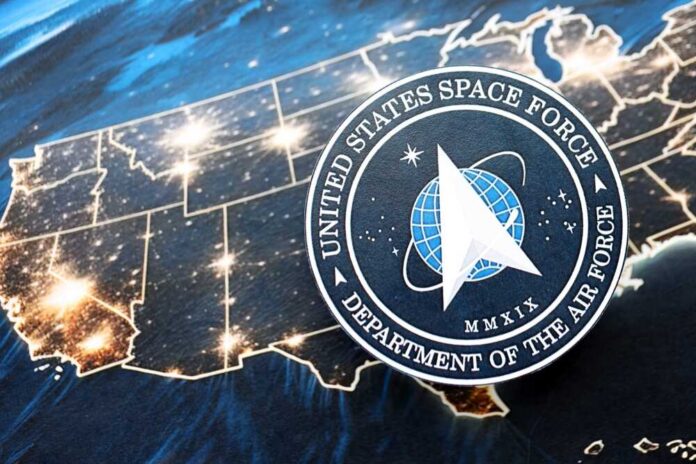
The United States has a weapon parked in orbit right now, and the Air Force just said so out loud.
Quick Take
- Air Force Secretary Troy Meink confirmed the United States has deployed an “on orbit” space weapon to protect American forces.
- He made the announcement at the Air, Space and Cyber Conference in Maryland, directing his warning at China and Russia.
- The statement follows years of Air Force leaders calling space a “warfighting domain” that needs active defense.
- International law bans weapons of mass destruction in orbit but does not ban all military activity there.
A Blunt Admission From The Air Force’s Top Civilian
Troy Meink did not hedge. He told a room full of government, military, and industry leaders that the United States now has a weapon stationed in space and plans to use it to guard American troops and satellites.
The moment marked the first time the Air Force publicly confirmed a deployed space weapon, rather than just talking about future plans or research programs.
Meink framed the disclosure as a message, not a boast. He wanted Beijing and Moscow to know Washington will defend its assets above the atmosphere the same way it defends them on land, sea and air. Reporting on the speech described it as a “not-so-subtle warning” aimed squarely at America’s two biggest strategic rivals.
Space Has Been Called A Battlefield For Years
This did not come out of nowhere. Back in 2022, then-Secretary of the Air Force Frank Kendall told a packed Space Symposium crowd that “space is a warfighting domain now.”
He argued the United States had to counter adversaries who were leaning harder on space to support operations on the ground. Kendall spent years pushing the Air Force and Space Force to modernize faster because he believed the threat was already real, not theoretical.
For the first time, the United States has confirmed it has weapons in spacehttps://t.co/eT7Frt1sDG
— ABC 33/40 News (@abc3340) September 15, 2026
By 2023, Kendall was still hammering the same point, telling audiences that space capabilities sit at the center of America’s strategy of “integrated deterrence.”
He said the Space Force needed transformational change to keep pace with rivals building their own counterspace tools. Meink’s confirmation this year reads like the next chapter of that same story, moving from warnings about the future to a statement about what already exists.
Why This Does Not Break International Law
Some readers may wonder if any of this violates treaties. It does not appear to. The 1967 Outer Space Treaty bans nuclear weapons and other weapons of mass destruction in orbit, along with military bases on the moon or other celestial bodies. It does not ban every kind of military activity in space.
That legal gap has let major powers build up defensive and deterrent capabilities in orbit for decades without technically crossing a treaty line.
That gap explains why officials like Meink and Kendall can talk openly about “space control” and deterrence without triggering a treaty violation. It also explains why other nations, including China and Russia, have pursued their own counterspace programs for years. Washington’s public confirmation simply puts America’s own capability on the record instead of leaving it as an open secret.
What This Means Going Forward
Americans who have long argued for peace through strength should see this as overdue clarity, not alarming news. A nation that hides its capabilities invites rivals to guess wrong and test limits.
Publicly stating that America can defend its satellites sends a clear signal that reckless moves in orbit carry real consequences, which is exactly the kind of deterrence that keeps adversaries cautious.
Beijing Condemns Washington Following Public Confirmation of Orbital US Space Weapons
Chinese Foreign Ministry spokesperson Guo Jiakun condemned the U.S. after Air Force Secretary Troy Meink publicly confirmed that the U.S. Space Force has deployed operational "on-orbit space… pic.twitter.com/rdkdABpv3I
— EuroPost Agency (@EuroPostAgency) September 15, 2026
Expect more of this kind of straight talk from the Pentagon, not less. As China and Russia keep investing in their own orbital tools, American officials will likely keep explaining, in plain terms, why the United States is doing the same. Deterrence only works if the other side believes it, and belief starts with a clear public statement like the one Meink just gave.