
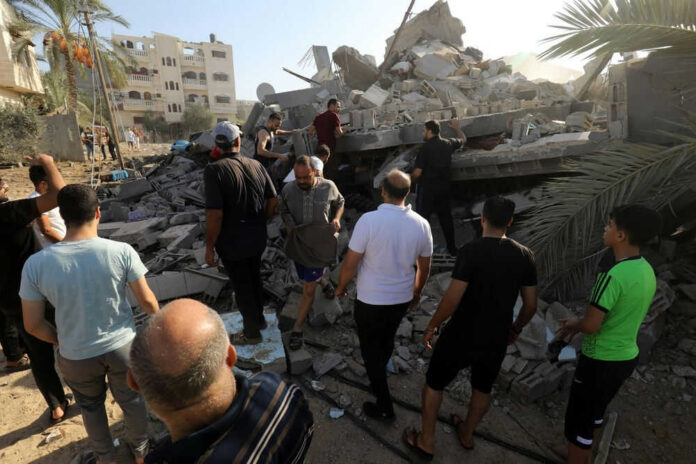
A war-damaged residential building in Gaza City collapsed overnight, killing families as they slept and leaving rescuers digging through rubble for survivors.
Story Snapshot
- A six- or seven-story residential block in southwest Gaza City failed before dawn.
- At least a dozen people died, with reports ranging from 8 to 19 dead so far.
- Rescue crews worked without heavy machinery and searched for people still trapped.
- The building had housed displaced families after earlier strikes weakened its structure.
What Happened And When Rescuers Arrived
Local medical and civil defense sources said the building collapsed around 2:15 a.m. in southwest Gaza City. People inside were sleeping, many of them displaced from other neighborhoods. The Palestinian Civil Defense reported active search and rescue under dangerous debris fields and without sufficient heavy equipment.
Early counts varied as bodies were recovered and the injured were evacuated. Several families were still unaccounted for when morning broke and the search widened into nearby alleys and courtyards.
At least 20 people killed and dozens missing after war-damaged building collapses in Gaza, local rescue teams say https://t.co/7kDFDGdrli
— BBC Breaking News (@BBCBreaking) September 16, 2026
Wire services quickly converged on the core facts. It was reported that 19 were dead and 25 were injured, with rescuers digging for dozens more under the rubble. A dispatch cited 11 dead and noted the structure had been previously damaged by the war.
Other reports placed the toll between 8 and 13 as teams clawed through collapsed floors by hand. These numbers reflect the chaos of early rescue windows, not doubt about the collapse itself.
Why The Building Failed And Who Lived There
Residents said the block had absorbed earlier damage in the fighting and later became a shelter for displaced families. Layers of prior structural harm, makeshift repairs, and overcrowding raise risk in any building. In Gaza, that risk compounds fast.
Months of conflict have left large parts of the city scarred, with weakened columns, cracked shear walls, and compromised stairwells. When one load-bearing section gives way, upper floors can pancake, creating narrow survival voids and deadly dust pockets.
That pattern tracks with broader assessments of Gaza’s built environment during the war. Satellite and field analyses document widespread damage to housing across the strip, leaving many people to sleep in buildings never certified as safe.
Regional reviews point to a cycle: damage, displacement into the least-worst shelter, then secondary collapse as stressed structures finally fail. This is not a one-off tragedy; it is a predictable hazard in a city where repair crews and inspectors cannot work at scale.
Rescue Constraints That Turn Minutes Into Hours
Rescue workers relied on basic tools, volunteer lines, and neighborhood crews to move slabs and sift dust. The Palestinian Civil Defense cited a lack of heavy equipment, which slows tunneling and widens the window where survivors can suffocate or bleed out.
In past incidents, bulldozers arrived late or not at all due to access and fuel limits, and teams worked through storms or nighttime blackouts. Those same constraints were in play here, pushing responders to choose between speed and safety at every cut.
Local crews showed courage but lacked tools that any county fire department in the United States would consider standard. It should not require a convoy or a truce to bring in a crane to lift a slab off a child. That is not politics; it is basic decency and order.
Numbers Will Settle, But The Duty Is Clear
Casualty counts will harden as recovery continues and hospitals reconcile admissions with bodies recovered. Early reports put the death toll between 8 and 19 and listed more than two dozen injured, with others still missing as daylight expanded the search grid.
One sentence of caution belongs here: these are preliminary tallies as responders clear unstable decks and stairwells. The command focus remains the same regardless of the final count—save who can be saved, identify the lost, and secure nearby structures.
City blocks across Gaza carry the same hidden risk profile. Some stand until a gust, a crowd on a landing, or a modest aftershock pushes them past the edge.
Practical steps save lives: survey damaged buildings; mark unsafe entries; clear ad hoc shelters from load-bearing zones; stage cutting torches, airbags, shoring lumber, and medical kits within walking distance; and train neighborhood teams in basic search patterns.
Sources:
apnews.com, reutersconnect.com, reuters.com, abcnews4.com, en.abna24.com