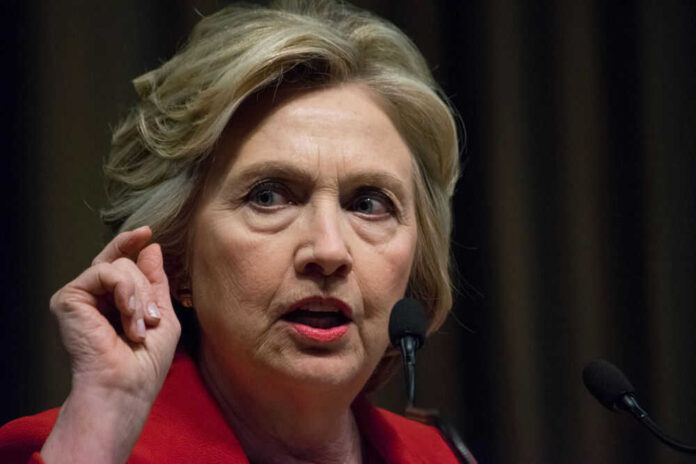
Even to this day, millions of Americans keep wondering if the FBI botched the Hillary Clinton email investigation.
In a surprising turn of events, that certainly seems to be the case given what has just been exposed.
At a Glance
- The DOJ declassified a report alleging FBI failures in the investigation of Hillary Clinton’s email probe.
- The report claims the FBI ignored key evidence.
- Senate Republicans demand accountability for the perceived mishandling.
- The controversy adds to the debate over FBI bias in politically sensitive cases.
FBI’s Oversight in Clinton Email Probe
A newly declassified report from the Department of Justice’s Office of Inspector General (DOJ OIG) reveals damning allegations about the FBI’s handling of the Hillary Clinton email investigation.
According to the report, the FBI neglected to thoroughly investigate key pieces of evidence, such as thumb drives potentially containing sensitive information and did not pursue certain investigative leads. This revelation comes as a shock to many who believed the case was thoroughly examined back in 2016.
The “Clinton annex,” a crucial appendix to the 2018 DOJ OIG report, was only declassified and released in July 2025 after persistent requests by Senate Judiciary Committee Chairman Chuck Grassley.
The annex suggests a more severe lack of investigative diligence than previously acknowledged, fueling the fire for those who argue that political bias played a role in the FBI’s approach to this case compared to others.
Political Bias or Procedural Error?
The Clinton email investigation coincided with the 2016 presidential campaign, making it a politically charged case from the outset.
The FBI’s handling of this case has often been compared to the aggressive approach it took in the Trump-Russia investigation, leading to accusations of a double standard.
The 2018 DOJ OIG report criticized the FBI for procedural errors but stopped short of alleging intentional misconduct.
However, the newly released annex points to a more serious lack of investigative rigor, suggesting that the FBI failed to review all available evidence and ignored recommendations for further searches.
This finding has prompted renewed scrutiny of the FBI and DOJ, with congressional Republicans calling for more accountability and transparency in how such politically sensitive investigations are conducted.
The Role of Key Figures
The investigation into Clinton’s use of a private email server, which she used during her tenure as Secretary of State from 2009 to 2013, initially concluded in July 2016 when then-FBI Director James Comey announced that although Clinton and her staff were “extremely careless,” no charges were warranted.
The declassification of the annex has reignited discussions about the roles of key figures such as Comey, former FBI Deputy Director Andrew McCabe, and former Secretary Clinton herself.
Senate Judiciary Committee Chairman Chuck Grassley has been a pivotal figure in the push for transparency, spearheading efforts to declassify the annex.
His actions have been backed by Attorney General Pam Bondi, who authorized the release.
Grassley has been vocal about his concerns, stating that the annex “shows an extreme lack of effort and due diligence” in the investigation, reinforcing the narrative of political bias.
Long-term Implications and Public Perception
The release of the annex has profound implications for both the short and long term. In the short term, it has reignited debates over the FBI’s impartiality and the politicization of federal investigations.
In the long term, there could be an erosion of public trust in federal law enforcement, potentially leading to calls for reforms in investigative procedures and oversight mechanisms.
The broader public is left questioning the integrity of these institutions, with many conservatives feeling vindicated in their skepticism of a system they believe has been weaponized against them.
Political figures such as Clinton, Comey, and McCabe are under renewed scrutiny, while federal agencies face reputational risks that could have lasting consequences.