

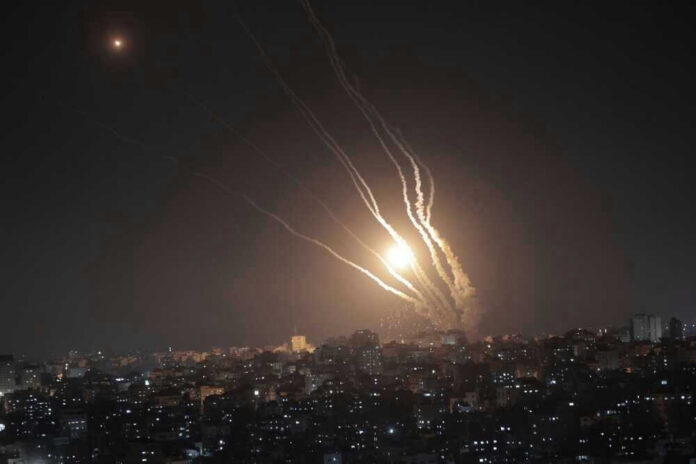
Russia fired a weapon at Kyiv that its own president called impossible to intercept, and the world is only now beginning to grasp what that actually means.
See the video below
Story Snapshot
- Russia launched one of its largest combined strikes on Kyiv, reportedly firing approximately 90 missiles and over 600 drones in a single overnight assault.
- Ukrainian President Volodymyr Zelenskyy stated Russia used the Oreshnik hypersonic ballistic missile, describing it as impossible to intercept and capable of carrying a nuclear warhead.
- Multiple outlets reported this was only the third confirmed use of the Oreshnik missile system during the war, signaling a deliberate escalation rather than a routine strike.
- Russia’s defense ministry framed the attack as retaliation for Ukrainian strikes on civilian facilities inside Russian territory, without specifying which munitions were used.
The Scale of the Strike Demands Context
Russia’s overnight assault on Kyiv was not a surgical strike. Reports describe a barrage of roughly 90 missiles and more than 600 drones targeting the Ukrainian capital and surrounding regions, killing at least four people. [1]
That volume of munitions is designed to overwhelm air defenses, exhaust intercept inventories, and ensure that at least some weapons reach their targets. Within that saturation attack, Ukrainian officials say one weapon stood entirely apart from the rest.
Zelenskyy posted on Telegram that Russia deployed the Oreshnik hypersonic ballistic missile during the assault, calling it a weapon that air defense systems cannot stop. [1]
Ukrainian authorities echoed that identification, and several major international outlets reported Russia itself confirmed the Oreshnik’s use in the broader strike package. [2]
That convergence of Ukrainian claims and apparent Russian acknowledgment gives the identification more weight than a single official statement normally carries, though independent forensic confirmation has not been publicly presented.
What the Oreshnik Actually Is and Why It Matters
The Oreshnik is an intermediate-range ballistic missile capable, in theory, of carrying a nuclear payload. [3]
It travels at hypersonic speeds, meaning it moves faster than five times the speed of sound during terminal approach, and current Ukrainian air defense architecture was not designed to intercept a weapon with that flight profile.
Calling it simply a missile undersells what it represents strategically. It is a message wrapped in a warhead, and Moscow knows exactly how that message reads in European capitals.
Russia uses hypersonic Oreshnik missile in mass attack on Kyiv https://t.co/1uODtIX6Pt
— The Washington Times (@WashTimes) May 24, 2026
Reporting indicates this was only the third time Russia has used the Oreshnik in the conflict. [2] That restraint is itself a signal. Russia has not been deploying this weapon routinely.
Each use is calculated, and using it against Kyiv specifically, the symbolic and political heart of Ukraine, rather than a military installation in the east, suggests the Kremlin wanted the psychological impact to land as loudly as the physical one. European leaders condemned the strike almost immediately. [4]
Russia’s Retaliation Claim Deserves Scrutiny
Moscow’s defense ministry stated the attack was retaliation for Ukrainian strikes on civilian facilities inside Russian territory, with some reports citing a student dormitory strike in Luhansk as the specific trigger. [5]
Russia has used the retaliation framework consistently throughout this war to justify escalatory strikes, and the pattern is worth recognizing for what it is: a political framing designed to shift moral responsibility rather than a genuine proportionality argument.
Firing 600 drones and 90 missiles, including a nuclear-capable hypersonic weapon, at a capital city is not a proportional response to any single prior incident by any reasonable standard.
BREAKING:
Russia Confirms Use of Oreshnik Hypersonic Missiles in Ukraine AttackBila Tserkva, Ukraine — In a striking display of military technology, Russia has officially confirmed the deployment of Oreshnik hypersonic missiles in an attack on a Ukrainian military airfield… pic.twitter.com/EuYXXgNfWu
— the FlyingDutchmen🇳🇱🇵🇭🇷🇺🇭🇺🇷🇺 🇨🇳 (@GerritdeH) May 25, 2026
What makes the Oreshnik’s deployment particularly significant is the evidentiary gap that surrounds it.
Weapon nomenclature across reporting varied, with the same system referred to as Oreshnik, Archnik, and Areshnik in different transcripts, reflecting translation inconsistencies rather than genuine uncertainty about the system. [3]
No debris analysis, radar track data, or independent forensic confirmation has been made public, which is typical of active wartime operations where both sides guard sensor and intelligence capabilities closely.
The identification rests on Ukrainian official statements and apparent Russian confirmation, which is a stronger evidentiary foundation than either side alone, but still short of the technical documentation that would settle the question permanently.
What is not in dispute is that Kyiv burned, people died, and Russia chose to use one of its most powerful non-nuclear weapons to make a point it apparently felt could not be made any other way.
Sources:
[1] YouTube – At least 4 dead after Russia fires hypersonic Oreshnik …
[2] YouTube – Russia’s deploys Oreshnik hypersonic missiles on deadly …
[3] YouTube – Russia hits Kyiv with hypersonic missile in massive assault
[4] YouTube – Russia condemned for using Oreshnik hypersonic missile …
[5] Web – Russia uses hypersonic Oreshnik missile in mass attack on …