
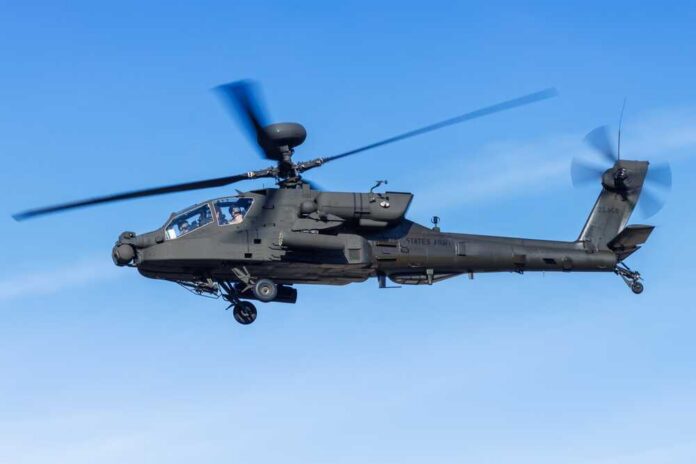
Two Fort Hood soldiers died when their Apache went down in a Texas field, and the fire told the rest of the story.
Story Snapshot
- An AH-64 Apache from Fort Hood crashed near Salado, killing both soldiers on board.
- The crash sparked a fast-moving grass fire and forced nearby evacuations.
- Bell County took a 911 call just after 1:30 p.m. and rushed to the scene.
- Officials said the helicopter hit open land and missed homes and buildings.
What happened in the Bell County sky and on the ground
U.S. Army officials confirmed that an AH-64 Apache based at Fort Hood crashed near Salado on Wednesday afternoon, killing both soldiers aboard. Bell County dispatchers received a 911 call shortly after 1:30 p.m., and deputies and fire crews sped to a field along Farm-to-Market roads as smoke rose over pastureland.
Responders found a violent crash scene but no impact to homes. Firefighters shifted from rescue to fire control within minutes as flames ran through dry grass.
Two people were killed when a U.S. Army Apache helicopter from Fort Hood crashed in Salado, Texas, on Wednesday, local authorities said. https://t.co/dvVsSE11DW pic.twitter.com/0GpBMFBSKd
— CBS Evening News with Tony Dokoupil (@CBSEveningNews) August 12, 2026
Reporters on scene described a two-seat attack helicopter downed in open country, with wreckage spread across a field and heat pushing crews back. Fort Hood officials confirmed the aircraft belonged to the post’s Apache fleet.
The crash lit a brush fire that grew fast in hot, windy conditions, prompting road closures and some evacuations until crews gained a line on the flanks. Authorities announced two fatalities at the scene. Names were withheld until families could be notified.
What we know, what we don’t, and why it matters
Officials named the aircraft type, location, and deaths with confidence. The cause remained under investigation. That is standard in military aviation. Early facts fix the where, what, and who. The why takes time and data: maintenance logs, cockpit systems, training schedules, and witness statements.
The gap can stir rumors. It should not. The Apache is rugged. Crews train hard. When one crashes, something meaningful failed, and investigators will track it down.
The public saw smoke, evacuations, and flashing lights. The families felt the knock at the door. The Army now owes them and the force a clear account.
That begins with the Army Combat Readiness Center’s process: secure the scene, document debris patterns, recover components, and match them to flight and maintenance records. Bell County records will also anchor the timeline. Those logs already set the clock at just past 1:30 p.m. when the first alarms hit 911.
Fire, fuel, and the thin line between impact and ignition
A crash that sparks a grass fire is a race between heat, wind, and manpower. Jet fuel, hot metal, and shattered parts can light dry pasture like a matchbook. Crews in Salado faced shifting winds and open fields.
They focused on containment and keeping fire off homes and roads while law enforcement secured the perimeter. Reports noted that the helicopter did not hit structures, a break that prevented a far worse scene and let firefighters pick better ground to fight the fire.
Officials with Fort Hood confirmed that the crash in Salado involved an AH-64 Apache attack helicopter based at the installation. https://t.co/IGDavtoQ0L
— THV11 (@THV11) August 13, 2026
This fire also shows why fast coordination matters. Local departments called in mutual aid, set closures, and moved neighbors out early. That kept roads clear for engines and tankers and cut the risk of secondary crashes in smoke. The same playbook repeats across Texas each summer, and it worked here: protect life first, then property, then the black line that stops the burn.
Accountability, culture, and the common sense test
Some will ask why the Army flies complex aircraft over farm country. The answer is readiness. Aircrews must train in real air and real weather. Common sense also asks for strict stewardship.
If a maintenance lapse, training shortfall, or parts failure played a role, the Army must fix it, publish the fix, and verify the change in the field. Duty and accountability travel together in uniform, or they fail together. Clear findings and corrective action honor the fallen more than speeches.
Officials so far have stayed inside their lane: confirm the loss, describe the scene, and hold back on cause until evidence supports it. That is the right call. Media reports varied on acres burned and containment, which often happens in a live fire.
The core facts did not move: an Apache from Fort Hood crashed near Salado; two soldiers died; a brush fire followed; homes were spared direct impact. That backbone is strong enough for now, and it gives investigators room to work.
What to watch next
Expect a preliminary safety note first, then a fuller report with findings and recommended fixes. Watch for details on flight purpose, crew experience, maintenance history, and any alerts from onboard systems. Local records may refine the timeline.
State fire data may lock down ignition points and spread. Each piece makes the picture clearer. When that picture is complete, the measure is simple: did leaders tell the truth fast, fix the root cause, and protect the next crew in the sky?
Sources:
cbsnews.com, abcnews.com, cnn.com, timesnownews.com, youtube.com