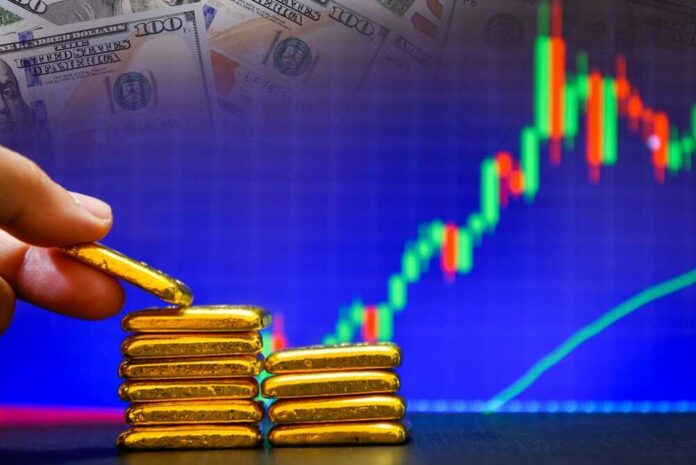
President Trump’s bold move to impose tariffs on European nations over Greenland sparks a gold price surge, alarming investors and shaking global markets.
Story Overview
- Gold prices hit new records amid U.S.-Europe tensions over Greenland.
- Trump’s tariff threats trigger precious metals rally.
- Gold surpassed $4,800 per ounce, driven by geopolitical instability.
- Investors flock to gold as a safe-haven asset against market uncertainties.
Gold Surges on Geopolitical Tensions
As January 2026 unfolds, gold prices have reached unprecedented levels, fueled by rising geopolitical tensions between the United States and Europe over Greenland. President Trump’s recent announcement of potential tariffs against eight European nations resisting his plans for Greenland acquisition has sent shockwaves through global markets.
This announcement has driven gold prices to a record-breaking $4,844.39 per ounce, highlighting the metal’s role as a safe haven amidst escalating trade friction.
Gold breaks new record on Greenland tariff threats, with forecast of $7,000 on the cards https://t.co/geiXpSTd12
— CNBC (@CNBC) January 21, 2026
The geopolitical landscape has shifted dramatically, with Trump’s assertive stance on Greenland exacerbating existing tensions.
European leaders, including French President Emmanuel Macron, have voiced strong opposition, emphasizing that coercion should not define relations between allies. As the dispute intensifies, investors are increasingly turning to gold, viewing it as a reliable asset amid the uncertainty surrounding U.S.-European relations.
Market Implications of Tariff Threats
The market has responded swiftly to the looming threat of tariffs, with gold prices surging past the $4,800 mark, a significant milestone in the metal’s ongoing rally. This surge is further amplified by a weakening U.S. dollar, which has made gold more accessible to international investors. The dollar’s slide to a two-week low has incentivized global buyers, reinforcing gold’s status as a non-yielding but secure investment.
The potential economic repercussions of tariff implementation remain a pressing concern for European economies, which now face the dual threat of geopolitical pressure and economic instability. The uncertainty surrounding Trump’s tariff strategy continues to unsettle markets, prompting investors to seek the safety of precious metals to hedge against potential disruptions in global trade.
Long-Term Outlook and Investor Sentiment
Looking ahead, major banks and financial analysts maintain a cautiously optimistic outlook on gold’s trajectory, with projections of prices reaching $4,800 to $5,000 by mid-2026. Despite speculative claims of a $7,000 price target, current expert forecasts remain more conservative. The ongoing central bank purchasing and anticipated Federal Reserve interest rate cuts are expected to provide structural support for gold prices throughout the year.
Amid these developments, market sentiment remains mixed. While fundamentals remain supportive, a recent Bank of America survey identified gold as the “most crowded trade,” suggesting potential vulnerabilities to profit-taking. As the global economic landscape continues to evolve, gold’s role as a hedge against market volatility and geopolitical risk remains firmly entrenched.
Sources:
Investing.com: Gold Surges Past $4,800/oz to New Record High Amid Greenland Tensions
Mining.com: Gold Price Soars Past $4,700 for New Record
Trading Economics: Gold Commodity Prices