
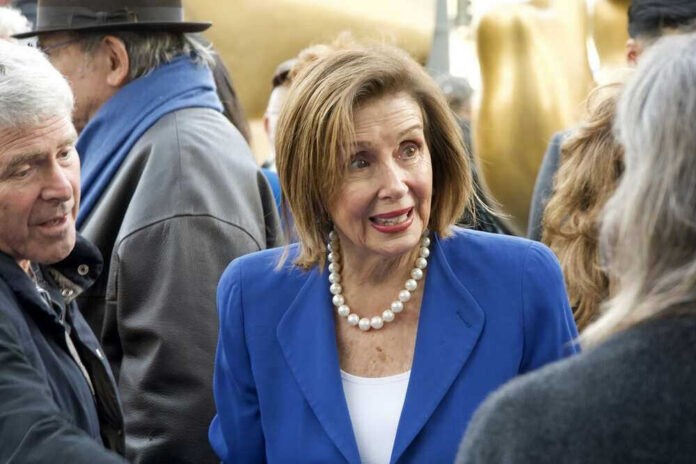
Nancy Pelosi drew a hard line on Israel by saying two Democrats’ reported views were “wrong,” and then dared her party to prove it with their actions.
Story Snapshot
- Pelosi called the positions linked to Zohran Mamdani and Abdul El-Sayed “wrong.”
- She said those views do not reflect Democrats in Congress.
- The criticism centered on rejecting Israel as a Jewish state, which the host labeled antisemitic.
- House Democrats are already split over aid to Israel, making her claim a stress test.
Pelosi’s on-record rebuke and what she meant
Nancy Pelosi responded on a recorded podcast to a prompt that tied Zohran Mamdani and Abdul El-Sayed to the claim that Israel should not exist as a Jewish state. She said the view was “more than concerning. It’s wrong.” She added that this position does not represent Democrats in the House of Representatives. The words were clear and forceful. They carried extra weight because Pelosi is a long-serving Democratic leader who helped define the party’s brand for decades.
Donny Deutsch framed the claim directly, saying that denying Israel’s right to be a Jewish state is antisemitic. Pelosi then rejected the position as wrong. The exchange did not present the full, original statements from either Mamdani or El-Sayed. That gap leaves room for debate about precise wording. But the public impact is the same: a top Democrat labeled the described view out of bounds and said House Democrats would distance themselves from it.
Why this hits a nerve inside the Democratic coalition
The party is already divided over Israel policy, and not at the edges. One report days earlier said nearly half of House Democrats voted during the last year to halt aid to Israel. That means moderation is no longer the simple default, at least on funding. Another account chronicled a broader rethink among Democrats about the U.S.-Israel relationship, including pressure for tougher conditions on aid and accountability for the Israeli government. Pelosi’s line-drawing conflicts with that drift.
Specific numbers sharpen the point. An outlet reported 103 House Democrats backed an amendment to eliminate $3.3 billion in aid. Representative Greg Casar argued the party needs a new approach and said taxpayers should not subsidize Israel’s military. House Democratic Leader Hakeem Jeffries opposed ending aid outright, yet said U.S. policy must change for the good of both Israelis and Palestinians. The center of gravity is moving, even if leadership still defends the alliance.
Where El-Sayed and Mamdani fit—and where facts get fuzzy
Coverage says El-Sayed criticized the U.S.-Israel relationship and opposed military aid. A recorded interview shows him calling Israel “not actually our friend” and warning it pulls the U.S. toward wars. None of that, on its own, proves he denied Israel’s right to exist as a Jewish state. The reports that prompted Pelosi’s remarks conflate positions at times: opposing aid, criticizing policy, and rejecting Israel’s Jewish character are not the same thing. Precision matters here.
Reports also lump Mamdani and El-Sayed together without cleanly assigning quotes. That creates a fog that helps headlines but hurts clarity. Pelosi’s judgment may still stand on principle—rejecting any call to erase Israel’s Jewish identity—but the evidentiary record, as published, does not give every exact line. Responsible readers should separate three buckets: criticism of Israeli policy, opposition to U.S. aid, and denial of Israel’s right to be a Jewish state. Only the last hits the bright red line Pelosi drew.
What “not representative” actually demands in practice
Pelosi said House Democrats do not share the alleged view. That is a challenge, not a mic drop. If party leaders agree, they can show it in measures that count: floor votes, committee statements, joint letters, and clear platform language. They can also defend legitimate criticism of policy while rejecting hostility toward Jewish nationhood. Conservatives will say this is common sense: defend an ally’s right to exist as a Jewish state, debate the aid levels, and condemn antisemitism without hedging.
🚨 Pelosi rips Abdul El-Sayed, says his views on Israel are "more than concerning":
“This new person in Michigan, we’ll see if he gets elected.” pic.twitter.com/zRtjdLvfPx
— Greg Price (@greg_price11) October 30, 2026
The political calendar raises the stakes. Reports say Pelosi rebuked El-Sayed’s stance while still urging support for his campaign. Voters see the split-screen: message discipline on Israel paired with a big-tent push to win seats. That balancing act will keep breaking news until Democrats settle two questions. First, what is the party’s nonnegotiable position on Israel’s Jewish identity. Second, how far will it go to tie U.S. aid to changes in Israeli policy. Watch the next votes, not the next podcast.
Sources:
yahoo.com, nytimes.com, cpr.org, arabcenterdc.org, randall.house.gov