
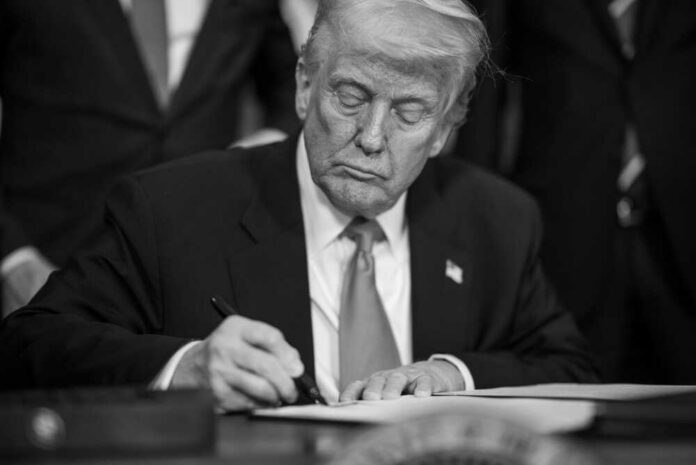
President Trump signed an executive order, creating a new women’s health division within the National Institutes of Health.
Quick Take
- Trump signed the order “Advancing Women’s Health to Improve Outcomes in All Phases of Life” on October 19, 2026.
- The order directs the Department of Health and Human Services to create a new Women’s Health Division within the National Institutes of Health within 90 days.
- A new White House Women’s Health Task Force will be co-chaired by Robert F. Kennedy Jr. and Chief of Staff Susie Wiles.
- First Lady Melania Trump championed the plan, which covers health from childhood through menopause and aging.
- The order does not list a dollar amount, so funding details are still unknown.
What The Order Actually Does
The signing happened at the White House, with Trump and First Lady Melania Trump both taking part. The official White House action names the new policy and makes clear this is a formal executive order, not just a speech or promise. It directs federal health agencies to act within a set timeline rather than leaving the goal open-ended.
The core instruction is simple. Health and Human Services must establish a new Women’s Health Division within the National Institutes of Health within 90 days of signing. That deadline turns a broad goal into a concrete deliverable federal agencies now have to meet on the record.
Alongside the new division, the order creates a White House Women’s Health Task Force. Robert F. Kennedy Jr., who leads Health and Human Services, will co-chair it with White House Chief of Staff Susie Wiles. Their job is to coordinate women’s health work across every federal agency involved, not just within one building.
Covering A Woman’s Whole Life, Not Just One Disease
White House materials describe the order’s reach in stages. It spans infancy, childhood, and the teenage years, then moves through pregnancy, midlife, menopause, and aging. That life-stage approach deliberately breaks from research models built around single diseases or narrow age brackets.
The Associated Press reported that the order specifically targets maternal health, mental health, and endometriosis as priority areas. Naming endometriosis matters because it is a condition that affects millions of women yet has historically drawn limited research attention and funding compared to its impact.
White House materials also describe plans to use advanced computing tools, including what they call super intelligence, to understand female biology better and speed up medical discoveries. The announcement does not spell out which systems, data sources, or safety rules would guide that work.
Why The Research Gap Is Real
This order did not appear out of nowhere. A National Academies review found women’s health research made up just 8.8 percent of National Institutes of Health spending between 2013 and 2023. That share actually fell to 7.9 percent by 2023, even as total funding grew. Conditions like endometriosis, fibroids, and polycystic ovary syndrome remain understudied relative to how many women they affect.
Congress first addressed this gap back in 1993, passing a law that required women be included in federally funded research and creating the Office of Research on Women’s Health. Three decades later, researchers say meaningful questions about female-specific conditions remain unanswered, which is the backdrop for this new executive order.
What Comes Next
The order sets a 90-day clock for the new Women’s Health Division to exist, but it does not guarantee staffing, office space, or a finalized budget by that date. Whether the division is fully running, funded, and producing research results will only become clear as that deadline approaches in early 2027.
The task force’s first actions, including any meetings, recommendations, or new agency directives, will offer the clearest early signal of how seriously the administration is treating implementation. For now, the signing itself stands as a documented, significant step toward restructuring how the federal government studies and funds women’s health.
Sources:
youtube.com, whitehouse.gov, apnews.com