
The president’s helicopter lifted off over Washington, a passenger jet rolled down the runway nearby, and now federal safety investigators want to know why those two aircraft were sharing the sky when protocol says they should not have been.
Story Snapshot
- Marine One carrying President Trump departed while commercial flights at Reagan National were still moving.
- Federal officials say there was a brief loss of required separation, but no real collision danger.
- The lapse appears tied to a rule created after a deadly 2025 crash near the same airport.
- The incident shows how aviation safety, bureaucracy, and presidential security collide in real time.
What Happened When Marine One Took Off
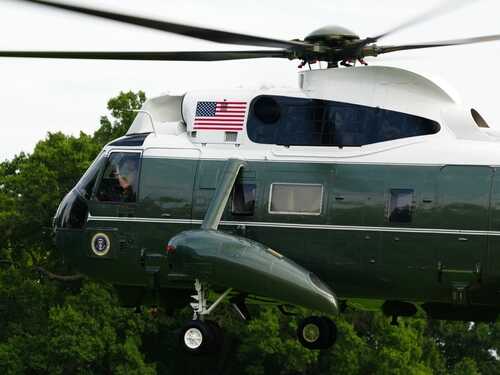
Aviation officials say the safety incident unfolded Tuesday around mid-afternoon, as Marine One lifted off from the Ellipse near the White House with President Trump on board. The helicopter was headed to Joint Base Andrews in Maryland, the first leg of a West Coast trip.
Under special rules for this airspace, commercial traffic at nearby Ronald Reagan Washington National Airport is supposed to stop three minutes before Marine One departs. That pause did not happen.
Instead, an American Airlines regional jet, an Embraer 170 operated by Envoy Air, was cleared for takeoff from Reagan National’s Runway 1 as Marine One was climbing out.
Air traffic control audio reviewed by local reporters captured Marine One’s crew calling the tower several times and saying they were “three minutes to lift,” a clear warning that the presidential helicopter was about to depart. Controllers responded with routine data, but commercial flights were still moving when the president’s aircraft took off.
Tuesday 'safety incident' with Marine One flight carrying Trump under investigation
Air traffic at nearby Reagan National Airport wasn’t stopped despite chopper take-off
'At NO point was the President in harm’s way' — White House pic.twitter.com/HZRd4j9GcL
— RT Intl (@RT_on_X) August 5, 2026
The Rules, The “Loss Of Separation,” And What FAA Says
The Federal Aviation Administration (FAA) requires aircraft near busy airports to keep at least 1.5 miles of horizontal distance and 500 feet of vertical distance between a helicopter and a commercial plane.
In this case, the FAA’s preliminary review found a “momentary loss of separation,” meaning the distance between Marine One and the Envoy jet dipped below those numbers before increasing again. The agency stressed that the aircraft were moving away from each other, not toward a collision point.
Federal officials say the controller stayed in contact with both pilots throughout the event. A spokesperson told reporters the two aircraft “did not appear to get dangerously close” and were not converging, so regulators do not consider this a near-crash in the technical sense.
The White House echoed that view, praising Marine One’s pilots as “some of the best aviators in the world” and stating flatly that “at no point was the President in harm’s way.” Both aircraft completed their flights safely, with no reports of abrupt maneuvers or passenger injuries.
Why Commercial Traffic Was Supposed To Stop
The shutdown rule that was missed here exists for a grim reason. In 2025, a United States Army Black Hawk helicopter and an American Airlines jet collided in midair near Reagan National, killing 67 people.
After that disaster, regulators tightened helicopter and jet operations around the airport, including the requirement that commercial traffic pause three minutes before Marine One departs. That buffer is meant to remove complexity from the controller’s workload and keep presidential flights well clear of other traffic.
Tuesday’s incident appears to be a departure from that post-crash policy. Multiple outlets, citing Federal Aviation Administration statements and unnamed officials, report that controllers did not halt commercial flights as required when Marine One was ready to go.
In plain terms, the system allowed a routine passenger jet to launch while the president’s helicopter was entering the same slice of sky. That looks less like bad luck and more like a human or procedural failure that demands clear answers and accountability.
The Investigation And The Bigger Safety Picture
The FAA and the National Transportation Safety Board have opened reviews to sort out what went wrong and why. Investigators plan to examine radar data, replay controller actions, and study routing decisions to see how the loss of separation developed and how to prevent a repeat.
They will look at whether the controller missed a step, whether communication between Marine One’s crew and the tower broke down, or whether the shutdown order simply was not executed as intended.
The FAA has launched an investigation into the failure to halt commercial flights at Washington Reagan National Airport during the takeoff of Marine One carrying President Donald Trump.https://t.co/zcU204nCoB pic.twitter.com/8KDQMzy2wn
— Ally Daily (@allydailycom) August 6, 2026
Aviation safety experts note that most accidents do not come from one dramatic mistake but from a chain of small lapses that line up just wrong. From that lens, a brief dip below separation standards with no real danger still matters because it shows stress points in the system.
For a president who travels often and an airport already marked by a fatal crash, many Americans will reasonably expect strict discipline, full transparency, and real fixes — not just reassurances that “everything was fine” after the fact.
Sources:
cbsnews.com, wsj.com, nbcnews.com, reuters.com, youtube.com, foxnews.com, foxsanantonio.com, facebook.com, aa.com.tr