
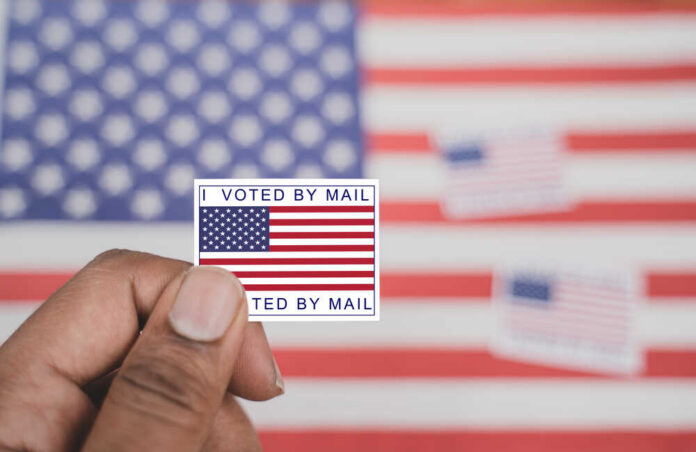
Mail ballots are leaving print shops while a Supreme Court order lets parts of President Trump’s verification plan press ahead, and that timing is the whole fight.
Story Snapshot
- Supreme Court allowed limited implementation of the mail-ballot order while cases continue.
- The order directs federal agencies to build citizen lists and shape Postal Service delivery rules.
- States and advocacy groups won earlier injunctions and argue the president lacks authority.
- Election offices face midstream rule shifts as ballots already move through the mail.
What the order actually does, and why it matters now
The March order tells the Department of Homeland Security to assemble state-by-state lists of adult United States citizens, tells the Department of Justice to target officials who issue ballots to ineligible voters, and tells the Postal Service to deliver ballots only to names on approved lists.
Reuters summarized those directives and the stated goal: stop ineligible voting and tighten verification. That is concrete action, not a white paper. The clock matters because ballots are already being mailed for the midterms.
The Supreme Court granted temporary relief on August 24, allowing parts of the plan to move forward while courts finish the job. The justices did not bless the entire scheme; they cleared a roadblock without deciding the final legality.
That narrow lane still matters on the ground. Federal agencies can keep building systems and testing mail rules, even as judges in Boston and elsewhere weigh the statutory limits and timing risks.
Where the legal lines are being drawn
Challengers say the Constitution gives states and Congress, not the president, the power to run elections. A judge in Boston agreed in a June ruling and called key parts “legally void” for exceeding executive authority, including the federal voter list and Postal Service gatekeeping.
An American Civil Liberties Union case separately blocked a Postal Service rule, stressing harm from confusion over mail ballots that millions plan to use. These rulings show real doubts in lower courts about the order’s scope.
Midterm elections have begun in the United States in a fog of confusion over mail-in voting, with ballots already going out as President Donald Trump presses courts to let him impose sweeping new restrictions on how they are handled.https://t.co/8S07JiNtez by @frankietaggart pic.twitter.com/ar0iYJZzMU
— AFP News Agency (@AFP) September 5, 2026
The administration argues that federal law gives the executive branch enough room to protect federal elections, prosecute fraud, and manage how federal agencies handle election mail.
The Supreme Court’s emergency action suggests at least some justices believe immediate, limited steps can proceed without upending election stability.
That sits beside the “anti-chaos” caution many courts apply near elections, a principle designed to avoid last-minute shocks to voters or officials.
Practical stakes for election offices and voters
Local officials must decide how to process mail ballots when federal guidance may change midstream. Some parts of the order depend on new data systems and interagency coordination that take time to build. That creates workflow tension: check eligibility with incomplete federal lists or rely on the state’s current rolls.
The Supreme Court opened space to keep building, but not a blank check. Offices plan for turnout, chain of custody, and delivery timelines measured in days, not months.
With the midterm elections approaching, the Trump administration on Sunday again asked the Supreme Court to let new restrictions on mail ballots take effect before November. https://t.co/SXJQPqwT86
— ABC News 4 (@ABCNews4) September 6, 2026
Common sense says accuracy and access both matter. Verifying that only eligible citizens get ballots protects confidence. So does avoiding rules that bounce real voters due to data mismatches. Opponents claim mass disenfranchisement; earlier court filings warned millions could be affected if the lists are wrong.
Supporters point out that prosecutions and audits work best with solid data, and that the order seeks that data. The record so far lacks public numbers of widespread, proven fraud at the scale implied by a nationwide curb.
What to watch between now and Election Day
First, watch whether the Department of Homeland Security discloses list-building methods, error rates, and fix-it procedures for mismatches. Second, look for the Department of Justice criteria for prioritizing cases and how that affects local officials.
Third, track the Postal Service’s operational guidance to carriers and election offices. Finally, expect more court skirmishes. The Supreme Court could still take a merits case and draw a bright line on presidential power over mail ballots, or leave that to appeals courts this cycle.
Sources:
pbs.org, cnn.com, thehill.com, supremecourt.gov, cnbc.com, washingtonpost.com