
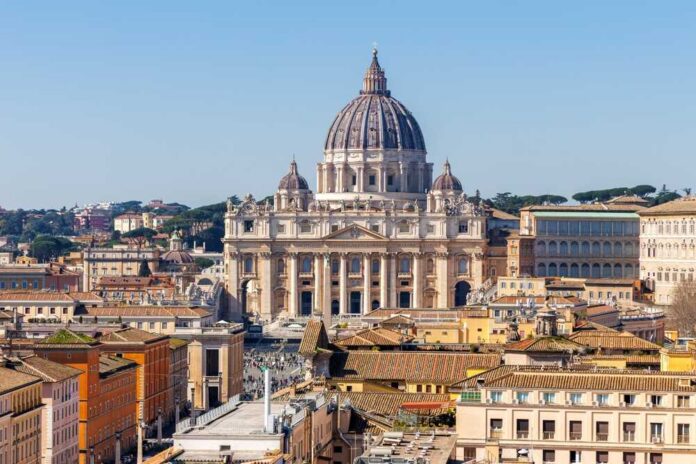
The Vatican confirmed that Pope Leo XIV has lung adenocarcinoma after surgeons removed the lower lobe of his right lung.
Story Snapshot
- The Holy See said intraoperative testing confirmed lung adenocarcinoma.
- Surgeons removed the lower lobe of the right lung; the operation had no complications.
- The procedure took place at Rome’s Gemelli Hospital, with a planned weeklong recovery.
- Pope Leo had disclosed a small, localized nodule days before surgery.
Vatican confirms diagnosis and successful surgery
The Holy See Press Office said doctors confirmed lung adenocarcinoma during surgery and removed the lower lobe of Pope Leo XIV’s right lung. The statement reported a three-hour operating room time, with about 90 minutes of active surgery, and no complications. The bulletin identified the cancer through intraoperative histology, meaning pathologists examined tissue during the operation and confirmed malignancy on the spot. The Vatican described the procedure as successful and emphasized that the Pope was recovering as planned.
Officials said the Pope underwent the operation at Rome’s Gemelli Hospital, the longtime site for papal care. Vatican News had announced the admission and forecast an expected hospital stay of roughly one week. That schedule aligns with common recovery timelines after a lower-lobe lung resection in stable patients. The Holy See said the surgical team completed the resection without reported intraoperative issues, reducing immediate risk and allowing earlier mobilization.
From a found nodule to a named cancer
Pope Leo told the faithful at the Angelus that doctors had found a small, well-defined nodule in his lung and advised intervention. The Vatican and major outlets reported that the mass appeared localized and suitable for surgical management. That sequence mirrors standard medical practice. Clinicians often detect a suspicious lung nodule on scans, remove it when appropriate, then confirm the exact tumor type under a microscope. That is how adenocarcinoma, a common non-small cell lung cancer, is definitively diagnosed.
Doctors base treatment plans on the resulting pathology. Imaging can suggest cancer, but tissue answers the key question. Professional guidelines explain that staging and planning start with histology, then evaluate tumor size, nearby lymph nodes, and any spread. A team looks for clean margins and checks lymph nodes to guide next steps. That process determines whether surgery alone is enough or if further therapy or close surveillance is wise.
What the Vatican shared and what medicine watches next
The Vatican’s update covered the diagnosis, the type of cancer, the lung location, and the lack of surgical complications. The communication did not include the tumor’s size, whether margins were clear, lymph-node results, or stage. Those details usually appear after the full pathology review. Medical staging considers how large the tumor was, whether it reached lymph nodes, and whether any spread occurred. That information drives risk estimates and follow-up choices for early-stage lung cancer.
BREAKING: Pope Leo XIV has been diagnosed with lung cancer after undergoing surgery to remove the lower lobe of his right lung, the Vatican confirms.
The 71-year-old pontiff spent approximately three hours in the operating room, with doctors confirming a form of lung cancer… pic.twitter.com/hZagJs3Nf3
— Fox News (@FoxNews) October 13, 2026
Early-stage lung adenocarcinoma found as a small, localized nodule can have strong outcomes when surgeons remove it completely. Published guidance for lung cancer care explains why teams sometimes proceed straight to surgery for a small, localized nodule, then tailor follow-up after the pathologist’s report. If lymph nodes are negative and margins are clear, doctors may choose surveillance. If features suggest higher risk, doctors may discuss adjuvant therapy to lower the chance of recurrence.
Health, duty, and a measured path forward
The Holy See set clear expectations on location, timing, and early recovery, which helps the Church and the public understand the road ahead. The Pope’s transparency about finding a small nodule days before surgery set a cautious, steady tone. The sequence—scan, surgery, intraoperative confirmation, and early recovery—fits the playbook for modern thoracic care. The coming pathology details will answer practical questions about return-to-duty pace, travel load, and long-term medical follow-up.
Practical takeaways for readers
Early detection matters. Doctors often find lung nodules during routine imaging or checks for other issues. Many nodules are not cancer, but some are. When scans suggest risk and a patient can safely have surgery, removal plus pathology gives the most certain answer. That was the Vatican’s report here. For families following similar paths, the steps to watch are the final pathology report, the staging summary, and the follow-up plan. Those three shape the months ahead.
Sources:
lifesitenews.com, abcnews.com, abc13.com, apnews.com, pbs.org, 2news.com, bbc.co.uk, pmc.ncbi.nlm.nih.gov, ncbi.nlm.nih.gov