
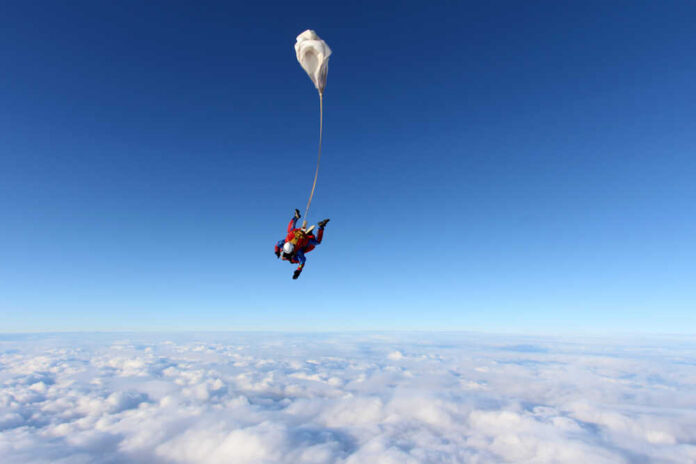
A parachute that does not open on time turns skill into silence in seconds.
Story Snapshot
- Police say a 33-year-old BASE jumper died at Rock Canyon after a likely parachute malfunction [2].
- Two more jumpers died near Mineral Bottom outside Moab, including guide Andrew “Andy” Lewis [10].
- Family and local media confirm the Rock Canyon fatality happened on impact [1].
- The sport’s danger stems from low altitude, narrow margins, and proximity to fixed objects, not hype [21].
Two Utah Fatalities Put BASE Jumping’s Brutal Margins Back in View
Police in Provo identified the Rock Canyon decedent as 33-year-old Weston Huff. They described him as an experienced skydiver and said he jumped alone and likely had a parachute malfunction [2]. A family-facing report said he died on impact after the fall [1].
On the same weekend, two people died near Mineral Bottom outside Moab, one of them the well-known guide Andrew “Andy” Lewis, according to local reporting [10]. Officials said both men died at the scene.
Two people were killed in a BASE jumping incident in Utah, including an extreme athlete who performed with Madonna during the 2012 Super Bowl, authorities said.
Read more: https://t.co/zazfAeKwMF pic.twitter.com/MAWoyNQBGq
— ABC News (@ABC) June 16, 2026
These statements carry weight because they come early from law enforcement and family, but they are not autopsy reports. They point to a malfunction in one case and confirm on-scene deaths in the other. They do not prove whether packing, gear failure, or wind caused the events.
That silence tells a larger truth. In BASE jumping, the cliff is close, the altitude is short, and any problem becomes a race with physics that the human body usually loses [21].
What Makes BASE Different From Skydiving Is Time, Distance, And Consequence
Skydivers exit with thousands of feet to spare. BASE jumpers step off bridges, towers, or cliffs with only a few heartbeats to get stable and fly. That short window leaves no slack for a bad body position, a slow pilot chute, or a line snag.
Studies and community records state that BASE fatalities cluster around terrain strikes and deployment errors because there is no altitude to fix mistakes. That is why risk estimates dwarf skydiving’s numbers [21].
Low altitude also means environmental quirks hit harder. Cliff-edge winds roll. Thermals switch. A gust at the exit can twist a canopy toward the wall. A featureless canyon can hide a rotor that steals lift. Even experts get caught.
That is not moral drama; it is mechanics. When a canopy points at rock at 200 feet, the math is bleak. This is why many practitioners treat packing like a ritual and choose sites and winds with monk-like caution. The margin is earned, not given.
The Names Matter, But So Do The Patterns And The Questions
Friends describe Huff as experienced. Reporters call Lewis a pro who guided others into the sport [10]. Their skills did not erase the inherent exposure. That aligns with a major thinking: freedom means owning the downside as well as the upside.
Adults make choices, and risk is not a policy glitch to regulate away. Still, the public deserves clarity on facts. Final medical findings and gear inspections would show whether these were pure hazards or avoidable failures.
Police and families gave the first picture. The next steps are methodical: inspect the canopy, container, bridle, and pins; map wind and terrain channeling; and confirm trauma patterns consistent with a failed or off-heading deployment.
If those findings surface, they should be stated plainly. If they do not, we should resist inventing villains. A sport can be both freely chosen and unforgiving. Utah’s canyons do not care how many jumps you have.
How To Think Straight About Danger Without Either Panic Or Myth
Public chatter often swings between “ban it” and “they knew the risk.” Neither helps. Better thinking starts with the mechanics. Fixed objects mean near-zero time. Proximity to rock means any off-heading or delay invites a strike.
Community data and mainstream summaries show BASE jumping remains vastly more dangerous than skydiving because of those two facts alone [21]. That frame keeps the focus on decisions that change odds: weather calls, site choice, pack jobs, and team support.
Local officials said both Mineral Bottom victims died at the scene, and Provo police pointed to a likely malfunction in Rock Canyon [2][10]. Those are sober, specific claims. They fit a wider pattern where most deaths come from impact, often within seconds of exit. The lesson is not new, but it is sharp.
The nearer the cliff, the smarter the plan needs to be. And sometimes even that is not enough. Respect the risk, tell the truth, and leave the hero stories at the trailhead.
Sources:
[1] Web – Utah canyon BASE jump kills 2, including extreme athlete who performed …
[2] Web – Man Dies After Parachute Fails to Open While Attempting to BASE …
[10] Web – Grand Canyon: Man dies after attempting illegal BASE jump: NPS
[21] Web – Base Jumping Risk : r/basejumping – Reddit