

The deadliest detail in the blast is not the body count, but the fact that nobody in charge seems willing—or able—to explain why a warehouse packed with mining explosives sat so close to ordinary families.
Story Snapshot
- More than 45 people died when a building storing mining explosives blew apart in northeastern Myanmar.
- Rescuers, not government officials, are the only clear voices describing what happened.
- The blast struck a rebel-held area near China, where oversight is weak and accountability is murky.
- The pattern echoes a larger problem: dangerous industries thriving where regulation and truth go to die.
A remote village turned into a crater in seconds
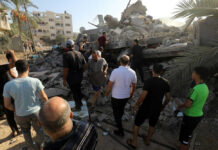
Rescue workers in northeastern Myanmar described a scene that could have been mistaken for a war zone: bodies scattered, buildings flattened, and a cloud of dust and smoke rising above Kong Tube Village in Namkham Township.
They reported that a building “said to have been storing explosives for mining” detonated with such force that more than 45 people died on the spot, with many more injured and rushed to overwhelmed hospitals nearby.[1][2][3] Children were among the dead, underscoring the proximity of this industrial hazard to everyday life.
Blast at a building in northeastern Myanmar, reportedly storing explosives for mining, has killed more than 45 people – rescuers pic.twitter.com/vsfFkLw5cJ
— TRT World Now (@TRTWorldNow) May 31, 2026
The building sat only a few miles from the Chinese border, in territory controlled by the Ta’ang National Liberation Army, an ethnic armed group that contests authority with Myanmar’s central government.[1] That geography matters. Where governance is split between armed actors, responsibility scatters. When something goes terribly wrong, everyone suddenly points somewhere else—or not at all. So far, no one in an official capacity has stepped forward to say: this was our site, our explosives, our failure.[1][2][3]
What we know, what we do not, and why that gap matters
Reporters and rescuers agree on several facts: the location, the death toll of more than 45, and that the structure stored explosives for mining rather than serving as an ordinary residence.[1][2][3] Those details alone tell a grim story about how closely high-risk industrial activity overlaps with civilian life. Yet beyond that, crucial questions hang in the air.
No report so far identifies whether the blast came from an accident, negligence, sabotage, or a deliberate attack.[1][2][3] Without a forensic analysis, this is tragedy without a clear cause, which is exactly how powerful interests often prefer dangerous incidents to remain.
The claim that the building stored mining explosives rests on what rescuers and local sources say they understood the property to be—an explosives storage site feeding local mining operations.[1][2][3] That aligns with common sense: this was not a gas stove going wrong.
The magnitude of the explosion and the scale of casualties fit the profile of a warehouse loaded with energetic material. Still, skepticism demands paper, not just testimony. No licensing file, inventory ledger, or government inspection record has yet surfaced to confirm what was legally supposed to be inside that building.
Conflict zones, weak oversight, and predictable disasters
This blast did not occur in a vacuum. It belongs to a larger pattern: resource-rich, conflict-ridden regions where mining money flows, armed groups compete, and regulators are either absent, compromised, or feared. In those corners of the world, explosives often sit close to homes, schools, and markets because risk is cheaper than safety and human life is discounted.
When something explodes, you get exactly what we see here—rescue workers hauling bodies, foreign headlines cycling through the numbers, and silence from anyone who might be held responsible.[1][2][3]
From a common-sense perspective, the deeper problem is familiar: if nobody owns the risk, ordinary people always pay the price. A responsible system would show permits, storage standards, distance rules from residences, and routine inspections—then produce those records after the blast to prove whether someone violated them.
In Myanmar’s northeast, that kind of transparency is fantasy. The central government struggles for control, the ethnic armed group runs its own show, and the public gets body counts instead of accountability.
Why this obscure explosion should still bother you
A faraway blast in a rebel-held village might seem like just another grim headline in a world full of them. Yet events like this serve as early warnings of where the global system bends and cracks. Mining explosives do not appear out of thin air; they come from supply chains, often with international suppliers, financing, and political cover. When oversight vanishes, the same logic that packs a warehouse dangerously close to homes can eventually bleed into bigger projects, bigger bets, and bigger risks that reach well beyond Myanmar’s borders.
The immediate facts are stark enough: dozens dead, scores injured, a building described as an explosives warehouse reduced to rubble, and a cause no one has publicly pinned down.[1][2][3]
The unanswered questions are more unsettling: who ordered the explosives, who approved the storage, who signed off on safety, and who now stands to benefit if the story fades before those answers emerge? Until someone is forced to respond with more than condolences, this blast is not just a tragedy. It is a warning label on a world that keeps playing with fire where it thinks no one important is watching.
Sources:
[1] Web – Rescuers say a blast at a building storing explosives in Myanmar has …
[2] Web – More than 45 killed, around 70 injured in blast at explosives storage …
[3] Web – More than 45 people killed in blast at building storing explosives in …