
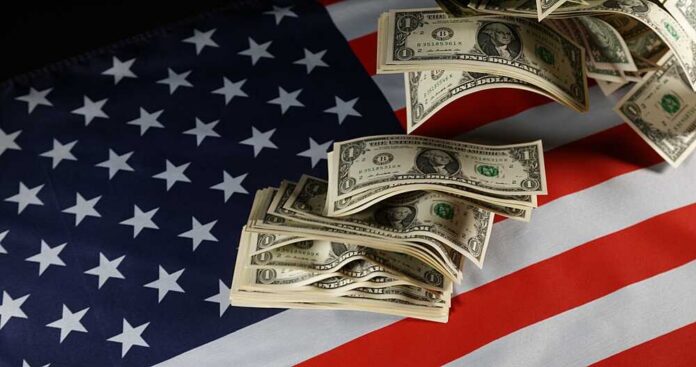
The most explosive part of the “anti-weaponization” saga is not the headline number, but how a $1.776 billion settlement fund blurred the line between public justice and private advantage for President Trump and his circle.
Story Snapshot
- President Trump dropped a $10 billion lawsuit over his leaked tax returns in exchange for creating a $1.776 billion Anti-Weaponization Fund funded by taxpayers.[2]
- Critics in Congress labeled it a partisan “slush fund” aimed at rewarding political allies, including January 6 defendants.[1][3]
- The Justice Department defended the fund as a lawful settlement mechanism modeled on prior claims funds, not a payout machine for Trump-world.[2]
- A federal judge blocked payouts and the administration ultimately backed away, reopening questions about Trump’s ability to personally benefit.[1]
A $10 billion lawsuit that turned into a $1.776 billion political grenade
President Trump did not just sue the federal government over his leaked tax returns; he turned that lawsuit into leverage to reshape how nearly $1.8 billion in taxpayer money might be distributed.[1][2]
After a former Internal Revenue Service contractor illegally disclosed his returns, Trump, his two eldest sons, and the Trump Organization filed a $10 billion suit against the Internal Revenue Service and the Treasury Department.[1] The eventual “solution” was not a straightforward damages check, but a novel Anti-Weaponization Fund housed inside the Justice Department.[2]
Trump's financial ties face scrutiny after moves benefiting allies and family | Click on the image to read the full story https://t.co/VuScxZM0wi
— kcranews (@kcranews) June 3, 2026
The Justice Department’s own order described the Anti-Weaponization Fund as a mechanism to compensate Americans who suffered “weaponization and lawfare” by prior administrations.[2] The fund would receive $1.776 billion from the federal judgment fund, a standing pot of money Congress created so the government can pay court judgments and settlements without a fresh appropriation every time.[2] On paper, any eligible claimant could apply; no statute said “Trump allies only.” That framing gave the administration a legal fig leaf and rhetorical cover.
Why critics saw a taxpayer-financed reward system for Trump’s allies
Members of Congress, particularly Democrats on the House Judiciary Committee, called the Anti-Weaponization Fund a “slush fund” from day one.[3]
Their concern was not just theoretical. Reporting and political statements highlighted that the fund could channel money to people who claim they were targeted for their politics, a category that Trump and his supporters repeatedly applied to January 6 defendants who attacked police at the Capitol.[1]
Representative Jamie Raskin introduced legislation specifically aimed at blocking what he called Trump’s effort to “steal” $1.8 billion from the Treasury for a Make America Great Again-aligned payout pool.[3] He argued the settlement structure converted a personal grievance—Trump’s anger over the tax leak—into a broad, ideologically tilted claims program financed by taxpayers who had no say in its design.[3]
That argument resonates with traditional conservative skepticism about executive-branch slush funds and creative uses of judgment money to bypass normal appropriations discipline.
How the Justice Department defended the fund as lawful and nonpartisan
The Justice Department insisted the Anti-Weaponization Fund was neither rogue nor partisan but a lawful settlement-based claims process.[2] Officials pointed to prior precedent, especially the Keepseagle settlement under the Obama administration, where a fund of about $760 million was created to compensate Native American farmers alleging discrimination by the Department of Agriculture.[2]
In both cases, the department used its authority over the judgment fund to structure a remedial mechanism with its own eligibility rules and claims process.[2]
The department’s order stated there were no partisan or ideological tests for eligibility; applicants had to demonstrate they suffered improper “weaponization” by federal officials and submit claims within defined procedures.[2] Any money left over would revert to the Treasury.[2]
From a rule-of-law vantage point, that defense has some force: agencies have long used the judgment fund to resolve complex disputes without dragging Congress into every settlement. The real dispute is whether this particular fund stayed within that tradition or stretched it beyond recognition.
The court blockade, the political backlash, and why the plan collapsed
A federal judge appointed by President Bill Clinton temporarily blocked the Trump administration from paying out claims from the Anti-Weaponization Fund, halting the rollout. News accounts describe the order as a serious setback that froze nearly $1.8 billion in planned distributions while the court examined statutory authority and separation-of-powers concerns.
The pause gave critics time to amplify their argument that the fund effectively laundered Trump’s personal litigation into a broad political patronage mechanism.[3]
federal judge appointed by Bill Clinton has blocked Donald Trump from moving forward his plans to create a $1.8 billion taxpayer 'slush fund' to compensate his political allies.
Judge Leonie Brinkema ruled Friday that the Trump administration cannot establish an…— Simo Saadi (@Simo7809957085) May 29, 2026
Under mounting congressional criticism and judicial scrutiny, acting Attorney General Todd Blanche told lawmakers the administration was no longer moving forward with the fund.[1] Reporting indicates that the Justice Department would comply with the court’s temporary block and that the administration decided to scrap the Anti-Weaponization structure altogether.[1]
That retreat has two implications conservatives should care about: first, the original Trump lawsuit may now revive, reopening the possibility of direct compensation; second, Congress was reminded how much power the executive can wield using existing judgment-fund authority.
What this fight reveals about Trump’s finances and conservative priorities
The Anti-Weaponization episode does not sit in isolation; it slots into a broader pattern of Trump intertwining public power, personal finance, and political loyalty.[1] The same period saw questions about defense contracts going to companies linked to his family and aggressive trading activity by the president himself.[1]
Critics argue the aborted fund was one more example of Trump viewing the state as a financial and political tool kit.[1] Supporters counter that the real scandal is years of politicized investigations and leaks targeting him and his movement.[2]
From a conservative, common-sense perspective, two truths can coexist. First, weaponized bureaucracy is real, and people hurt by abusive investigations deserve redress. Second, any remedy must be structured so that taxpayers are not subsidizing a president’s allies under the guise of justice.
The Anti-Weaponization Fund collapsed because it never convincingly answered that second concern. Future conservative leaders who want to unwind political lawfare will need cleaner, more transparent tools than a $1.776 billion settlement fund negotiated in the shadow of a president’s own lawsuit.
Sources:
[1] Web – Trump’s financial ties face scrutiny after moves benefiting allies and …
[2] YouTube – DOJ creates fund worth nearly $1.8 billion to pay Trump allies
[3] Web – Justice Department Announces Anti-Weaponization Fund