The Supreme Court just handed Alabama a major legal victory by allowing the state to use its Republican-drawn congressional map for this year’s elections — overriding a lower court that had blocked it as racially discriminatory.
Story Snapshot
- The Supreme Court cleared Alabama to use its 2023 congressional map, which includes one majority-Black congressional district, ahead of upcoming elections.
- A federal three-judge panel had previously blocked the map, ruling it intentionally discriminated based on race and diluted Black voting strength.
- The high court’s order halts that lower-court ruling, allowing the Republican-backed map to remain in effect while litigation continues.
- Justice Sonia Sotomayor dissented sharply, signaling the liberal wing’s strong opposition to the Court’s decision.
Supreme Court Steps In on Alabama’s Map
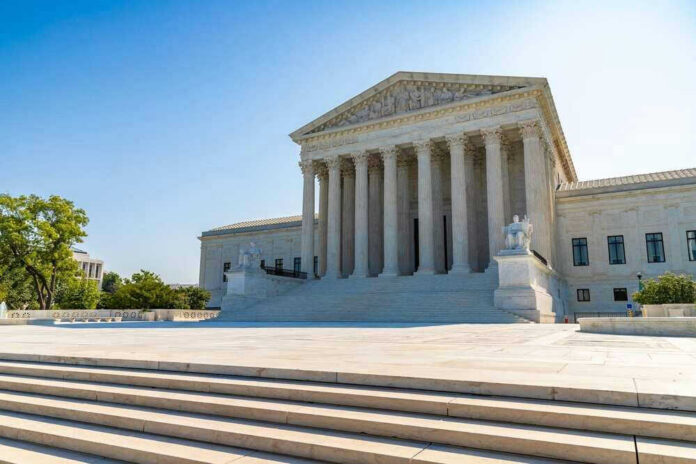
The U.S. Supreme Court on Tuesday evening allowed Alabama to use its 2023 congressional map — one that contains a single majority-Black district — for this year’s elections.
The ruling halted a lower federal court order that had blocked the map and demanded Alabama adopt a plan with two largely Black districts. The Court’s action means the Republican-drawn boundaries will govern how Alabama’s congressional seats are contested in 2026.
BREAKING — The U.S. Supreme Court allows Alabama to use the new 6R-1D congressional map for the midterm elections.
🔴 +1 GOP
🔵 -1 DEM pic.twitter.com/UZtpM9eeUN— VoteHub (@VoteHub) June 3, 2026
This is not the first time Alabama’s congressional maps have landed before the nation’s highest court. The Supreme Court’s earlier ruling in Allen v. Milligan found Alabama’s 2021 map likely violated Section 2 of the Voting Rights Act of 1965 by concentrating too few Black voters into a single district.
Alabama’s legislature responded in 2023 with a new map — still featuring just one majority-Black district — which then triggered a fresh round of legal challenges that ultimately reached the Court again.
Lower Court Had Declared the Map Unconstitutional
A three-judge federal panel had blocked the 2023 map after finding that Alabama’s Republican-controlled legislature knowingly drew boundaries that diluted Black Alabamians’ opportunity to participate meaningfully in the political process.
The panel concluded the legislature “well knew” a plan without an additional majority-Black district would run afoul of federal voting-rights protections. That ruling set up an emergency appeal to the Supreme Court, which moved quickly given the proximity of the election calendar.
These redistricting battles consistently become time-sensitive emergency litigation because election deadlines force courts to decide map validity before ballots are printed.
The result is a recurring cycle of competing court orders — legislature’s map versus court-ordered remedial map — with the Supreme Court frequently intervening through interim orders that do not always explain the full legal merits of the dispute. Alabama’s situation is a textbook example of that pattern playing out in real time.
What This Means for Alabama’s Congressional Seats
With the Supreme Court’s order in place, Alabama will proceed to elections using the 2023 map that Republicans enacted.
The state’s seven congressional districts will be drawn under boundaries that critics argue limit Black political representation, while supporters maintain the legislature acted within its constitutional authority to draw its own district lines. The underlying litigation will continue in lower courts, meaning the legal fight over Alabama’s maps is far from finished.
For conservatives, the ruling reflects a straightforward principle: elected state legislatures — not federal judges — should have the primary authority to draw their own congressional maps. Judicial intervention that overrides a democratically enacted legislative decision raises serious separation-of-powers concerns.
The Supreme Court’s willingness to halt the lower court’s order suggests at least a majority of justices share that concern, even as the broader legal questions around Section 2 of the Voting Rights Act remain unresolved and will continue working their way through the courts.
Sources:
[1] Web – BREAKING: Supreme Court Allows Alabama to Use Congressional Map that …
[2] YouTube – Supreme Court allows Alabama to use congressional map with one …
[3] YouTube – Alabama asks Supreme Court to allow use of congressional map …
[4] YouTube – Supreme Court rules on Alabama congressional map
[5] Web – Supreme Court halts order for Alabama to use US House map with 2 …
[6] YouTube – Supreme Court reinstates Alabama congressional map
[7] Web – What’s Happening with Alabama’s Redistricting Post-Milligan?
[8] YouTube – Supreme Court overturns 2023 ruling on congressional map in …