

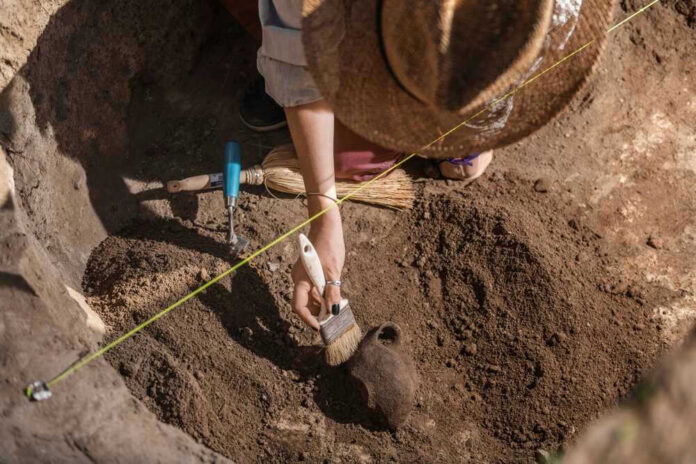
Two tiny gold rings pulled from a Thai rice field grave are quietly rewriting the story of how India and Southeast Asia first did business 2,000 years ago.
Story Snapshot
- Two gold rings about 2,000 years old were found with human bones at a new site in western Thailand
- One ring carries ancient Indian Brahmi script linked to a powerful zodiac sign, Pushya
- Archaeologists say the rings likely belonged to an Indian merchant buried far from home
- The find plugs Thailand into a wider map of early gold trade across Southeast Asia
Discovery in a quiet rice field
Villagers in Phetchaburi province did not expect history to be buried beneath their rice field. They first spotted broken pieces of bronze drums in the soil, the kind linked to ancient ceremonies and status.
That alert led Thailand’s Fine Arts Department to Don Yai Thong, now recognized as a late prehistoric burial site dating to the Iron Age, roughly 1,500 to 2,500 years ago. Excavations soon revealed human skeletons, pottery, jewelry, and signs of wealthy burials, not simple farming lives.
Gold rings around 2,000 years old found at Thail archaeological site https://t.co/0tj6feMkkL
— Express & Star (@ExpressandStar) July 6, 2026
Last week, the dig team uncovered something different. Besides human bones, they found two gold rings, small but heavy with meaning. Officials describe them as approximately 2,000 years old, based on dating of the site and the style of the surrounding artifacts.
Nearby, they also found a gold bracelet on the same skeleton, again pointing to a person of wealth or rank in that community. What began as a local curiosity is turning into a major regional story.
The ring that speaks in Brahmi script
One ring is plain. The other ring speaks. Experts report that the inscribed ring is engraved in Brahmi, one of the earliest Indian writing systems used across the subcontinent more than two millennia ago.
Specialists reading the tiny letters believe they spell “pusarakhitasa,” which they say means “the one protected by Pushya,” a very lucky zodiac sign in old Indian astronomy. That is not random decoration. That is personal belief carved into gold.
Thai archaeologists and media call the pieces “ancient Indian gold rings,” and with good reason. The script, religious meaning, and style all point to Indian makers and Indian culture rather than early Thai workshops.
Turkish outlet Anadolu Agency, citing Thai sources, reports that experts believe the wearer may have been a merchant from an Indian trading community, traveling through mainland Southeast Asia almost 2,100 years ago. That fits wider evidence of Indian traders spreading goods and ideas by sea and land.
A merchant’s grave and a high-status burial
The context of the find tells us as much as the rings. Archaeologists found the rings directly alongside human bones at Don Yai Thong, within what appears to be a ceremonial burial of wealthy elites.
Thai officials say eight skeletons so far show bronze and gold jewelry, pottery, and objects that mark status and ritual, not poverty. Some local reports say the buried person wore a gold bracelet along with the rings, a sign of serious wealth for that era.
Experts in Thailand’s Fine Arts Department go further. They suggest the rings’ owner may have been part of the Vaishya caste, the traditional merchant and trader class in ancient India. That claim merchants carried gold, moved through ports, and paid for protection against both physical and spiritual risks.
While caste reading from grave goods is always a bit speculative, the link between trade wealth, Indian script, and burial far from India fits historical thinking on how commerce spread.
How gold proves early trade routes
Gold objects like these do more than sparkle. They act like pins on a map. Modern research on “metal exchange networks” in prehistoric Southeast Asia shows a striking pattern: many gold artifacts, but little hard proof of local mining or big gold workshops.
Scholars say most early gold in the region likely came from outside the region, especially India, carried in trade rather than dug nearby. That helps explain why high-value gold appears in elite graves rather than in every village.
Archaeologists in western Thailand have unearthed two gold rings believed to be around 2,000 years old at a newly discovered archaeological site, officials said. One of the rings found on Thursday was engraved with characters believed to be Bhrami script, an ancient Indian… pic.twitter.com/RHq56EFbwi
— Hindustan Times (@htTweets) July 6, 2026
Studies of early Southeast Asian gold ornaments point to shared styles across Thailand, Vietnam, Cambodia, and Myanmar, often tied to Indian religion and art.
Scholars from Yale and elsewhere argue that precious metals marked status and sacred power for local rulers as they joined wider Asian trade networks.
The Phetchaburi rings fit that model cleanly: foreign script, religious meaning, elite burial, and a site linked by drums and jewelry to long-distance exchange.
Why this matters beyond archaeology fans
This discovery matters beyond museum labels. First, it pushes back against lazy ideas that Southeast Asia sat in isolation until modern empires arrived. The grave in a Thai rice field shows people here trading with India, using zodiac signs, and wearing imported gold at least 2,000 years ago.
That aligns with respect for deep-rooted cultures that built their own status systems long before global bureaucrats and modern academics.
Second, the rings highlight how small finds can check big stories. Current scholarship admits we still lack clear evidence of major prehistoric gold mining in much of Southeast Asia, even where geology suggests it. Yet gold artifacts continue to appear in graves and hoards.
That tension reminds us: follow the actual objects, not fashion in theory. In this case, the objects say “India was here,” and “trade shaped this society,” in a language on a ring that we can still read today.
Sources:
abcnews.com, facebook.com, reddit.com, youtube.com, academia.edu